FEATURED HISTORY
The Cospatrick Story
A story of emigration, tragedy and remembrance with deep connections to the Wychwoods and repercussions far beyond them.

FEATURED HISTORY
A story of emigration, tragedy and remembrance with deep connections to the Wychwoods and repercussions far beyond them.
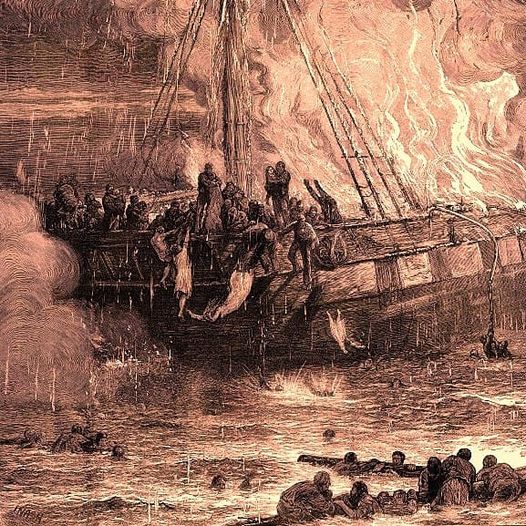
The Cospatrick on fire, from an engraving by Joseph Nash. The Graphic, 9 January 1875.
THE STORY
The Cospatrick story is a sad but important episode in the history of the Wychwood villages, but also a story with national and international repercussions.
On these pages we bring together a selection of Cospatrick-related research articles published over the years by the Society, alongside archive material covering the emigration years of the late nineteenth century.

150TH ANNIVERSARY PUBLICATION
On the 150th anniversary of the disaster in 2024, the Society compiled a new booklet giving an account of the Cospatrick story and its place in Wychwoods history.
The booklet was generously sponsored by Simon Randall and Shipton Parish Council and is available to read online.
REMEMBRANCE
On the village green at Shipton-under-Wychwood, next to the war memorial, stands a stone drinking fountain with a distinctive tall, conical spire.
It was erected in 1878 in memory of seventeen members of the Hedges and Townsend families from Shipton who lost their lives in the South Atlantic when fire destroyed the emigrant sailing ship Cospatrick, bound for New Zealand.
The brass plaque on the north side lists Richard Hedges, aged 56, Sarah his wife, 53; John Hedges, 24, and Sarah his wife, 22; Thomas Hedges, 27; and Charles Hedges, 18, both sons of Richard and Sarah.
The plaque on the south lists Henry Townsend, aged 62, Ann his wife, 53; George Charter, 31, Jane Townsend his wife, 35, and their two children; Henry Hedges, 30, and Mary Townsend his wife, 30, and their three children.
All the men were agricultural labourers.
From Margaret Ware’s article in Wychwoods History, Journal No. 14, 1999. Read the full article →
EXPLORE THE RESEARCH
Margaret Ware was one of several Society members who researched many aspects of emigration from the Wychwoods. The Society’s journals contain accounts of the Cospatrick disaster, assisted emigration, the journey to New Zealand and Australia, and the experiences of individual Wychwoods families.
FROM THE AUDIO ARCHIVE
Recordings from Society talks help place the Cospatrick story within the wider experience of emigration, agricultural labour and nineteenth-century life in the Wychwoods.
These two extracts explore very different parts of the emigrants’ experience. The first describes the logistical challenges surrounding the beginning of the journey. The second tells the moving story of one individual child at journey’s end.
Pamela Horn traces the rise and fall of the National Agricultural Labourers’ Union from its foundation in 1872 to the late 1880s, with particular reference to the Wychwoods emigration story and figures including Joseph Arch and Christopher Holloway.
Richard Garne’s talk follows the changing status of the farm labourer. Although parts of the material provide a stark account of rural working life, the recording also captures the humour and resilience with which farmworkers responded to their circumstances.
FROM THE FILM ARCHIVE
A section from a 1990 Victorian Evening of song and poetry. This extract explores themes of emigration and the Cospatrick.
FROM THE PHOTOGRAPHIC ARCHIVE

Shipton Church from the Cospatrick memorial
Estimated 1920s.

Shipton Green and the Cospatrick memorial
Late 1920s. The photograph shows water flowing from the memorial fountain.
FURTHER RESEARCH
Our external resources page brings together an expanding collection of online material relating to the Cospatrick and the wider history of nineteenth-century emigration.
CONTINUE EXPLORING
Explore a selection of material relating to the Cospatrick story published in The Wychwood.
Read about the April 2026 visit of a descendant of the Groves family to Milton-under-Wychwood.
A comprehensive article by John Stackhouse, reproduced with the author’s permission and first published in New Zealand Memories magazine in 2026.
READ ONLINE
A comprehensive article published with the permission of author John Stackhouse. It first appeared in New Zealand Memories magazine in 2026.