ABOUT THE SOCIETY
The First 40 Years
The Wychwoods Local History Society, 1981–2021
The story of four decades of research, discovery, publishing, photography, fieldwork and community history in the Wychwoods.

ABOUT THE SOCIETY
The Wychwoods Local History Society, 1981–2021
The story of four decades of research, discovery, publishing, photography, fieldwork and community history in the Wychwoods.
The history of the first twenty-one years of the Wychwoods Local History Society was admirably covered in an article by Dr Margaret Ware, which appeared in the Society’s Journal for 2003, Number Eighteen.
The first part of this history is based on that article.
01
The Initial Vision
How the Society began
02
The First Meetings
1981–1984
03
A Pattern Established
1984–1989
04
The 1990s
Highlights of the decade
05
The New Millennium
2000 onwards
06
Looking Ahead
The 2012 members’ survey
07
Towards Digitalisation
A new direction
08
Building the Digital Archive
Photography and records
During her work as a district councillor in the 1970s and 1980s local residents, especially the elderly, often related to Margaret Ware snippets of local legend. She realised there was a lot of fascinating information in the community, which was gradually being lost as people died or moved away. Another resident of Shipton, Mike Linfield, was interested in copying and preserving old photographs.
They each felt that a local history society would be an asset to the community and help meet these needs. So the evening of Thursday 2 April 1981 in Shipton’s old Beaconsfield Hall saw ‘The Inaugural Meeting of the Shipton and District Local History Society’.
John Steane, Keeper of the Field Section at Oxfordshire County Museum Services, was booked to give an introductory talk.
To their astonishment, well over 80 people attended. John Steane gave them every encouragement and many useful suggestions including the exhortation to ‘write everything down’.
Twelve people volunteered to form a steering committee:
Other committee members were Jack Chapman, Mike Linfield, Joan Smith, Margaret Ware and, briefly, Michael Harman.
After several committee meetings to hammer out a constitution and programme, the name of the new society became The Wychwoods Local History Society. It was affiliated to the Oxfordshire Local History Association. Initially the Society met four times a year, twice each at Milton and Shipton.
CHAPTER 02 1981–1984
At the first meeting on 22 September 1981 the chairman, Geoffrey Giles, spoke on ‘Tracing your Family History’, and in January, Tom Barrett from Milton spoke on ‘The Story of Shipton Gasworks’. These were followed by ‘Recording Oral History’ and ‘Vernacular Buildings’.
Details of the Society’s annual programmes from 1981–2021 are available in our archive.
It is worth recalling the original aims of the Society: ‘To foster interest in the local history of the area, to preserve past records, to carry out local surveys, to record all the work carried out and to place copies of such records in the archives of the Society and of suitable libraries’.
Several projects were recognised from the outset as being of high priority: a record of gravestones in Milton; a record of field names; a hedge species count; the compilation of a map of all historical and interesting sites; tape recordings of elderly folks’ memories and dialects; and as complete a photographic record as possible of buildings and sites.
This was quite an ambitious programme to contemplate and overestimated the number of members who would be prepared to be actively involved. There were therefore a few false starts, but a lot of good work was done from the beginning.
Mike Linfield and Norman Frost concentrated on their photographic recording and Gwen Allen led a group of about twenty members on successful hedge-counting forays.
An early task was the indexing and transcription of Shipton Court estate papers loaned from the parish council. A group transcribed the 1851 census returns from villages in the ‘old’ parish, which included Shipton, Milton, Ascott, Leafield, Lyneham, Langley and Ramsden. Subsequent decades’ returns have since been covered.
Neither the recording of village buildings nor the oral history project got off the ground in the early days.
The first newsletter, published in autumn 1981, contained an appeal to members for old photographs, maps, newspapers and items of historical interest. This first season saw 88 members and two editions of the newsletter.
After the first AGM in April 1982 the committee comprised Geoffrey Giles, Norman Frost, Mr and Mrs H Smith, Jack and Joan Howard-Drake, Mike Linfield, Jack Chapman, Gwen Allen, Margaret and Frank Ware and Sue Jourdan.
Frank Ware took over the treasurership, Margaret Ware became membership secretary, with Sue Jourdan and Joan Howard-Drake undertaking temporary secretarial duties. Six meetings were arranged for the following year plus the AGM, with a fund-raising members’ evening planned for the following January.
Jack Howard-Drake took over production of the twice-yearly newsletter after the death of Rob Long. Under the auspices of the Family History Society the Howard-Drakes started transcribing Shipton parish registers from 1538–1899, the Giles Ascott and Leafield, and the Ashtons Fifield, Idbury and Bould, a task which was to take several years.
In the winter of 1982/83 several members attended a series of ‘Introduction to Archaeology’ evening classes given by Clare Halpin. Little did the participants realise, as they squeezed onto the tiny chairs in the Wychwood School, what a seminal moment this was to be in the history of the Society, as she described the hitherto unheard-of activity of fieldwalking.
In January 1983 the fund-raising members’ evening with wine and a ploughman’s supper grew into a substantial exhibition and well over a hundred enthusiastic people crowded into Milton Village Hall.
Among the visitors was Dr Kate Tiller of the Oxford University Department for External Studies, who congratulated the Society and offered to hold a series of evening classes in the Wychwoods on ‘Sources of Local History’.
Membership stood at about a hundred. Audiences at meetings averaged nearly seventy at Milton, but only about forty at Shipton. Norman Frost was by this time corresponding with overseas members of the Groves family, among others, and the Society was beginning to receive an increasing number of enquiries from people researching their families.
Jack Howard-Drake succeeded Geoffrey Giles as chairman in 1984, and Rachel Grant joined the committee as meetings secretary. Norman Frost was busy compiling the Groves family tree and gave a series of classes to local girl guides taking their local history badge.
June 1984 saw the Society’s first summer field excursion when Frank Ware led a group around the common boundary of the Saxon Manors of Witney and Shipton.
In September, eleven members took part in the Society’s first fieldwalk. Elaborate preparations were made: a tent was put up, a stove and kettle were brought for tea and Tom Barrett, a stalwart St John Ambulanceman, brought his first aid kit as if the group were operating in the wilds of Africa instead of just down the Ascott Road.
Fieldwalks took place annually for many years afterwards, although preparations were greatly simplified.
CHAPTER 03 1984–1989
The 1984/85 season saw the pattern of eight meetings established, originally September to May. The evening of meeting was initially the second Tuesday in the month but this later changed to the third Thursday. With the opening of the new Beaconsfield Hall, meetings were held from September to June with no meeting near Christmas.
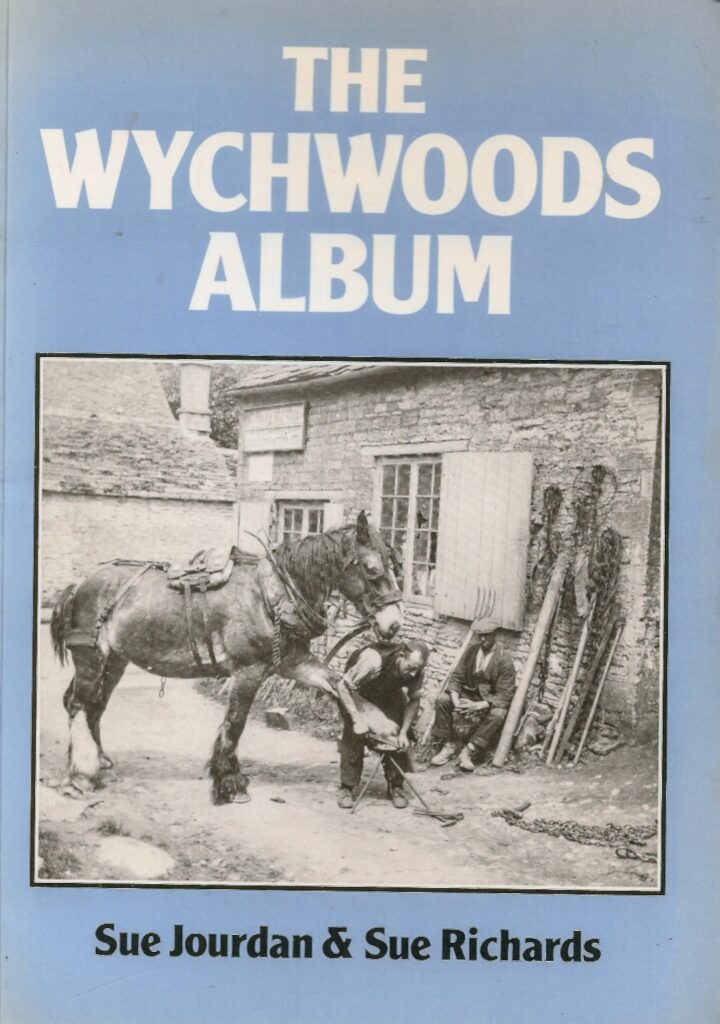
In November 1985 the Society published its first collection of historic photographs, partly funded by 385 advance subscriptions.
1985 was the Society’s busiest year to date. The first journal, Wychwoods History No. 1, was published in May at £2. Set in a typewriter face, it contained an appreciative preface by Kate Tiller, while Sue Richards’ original cover design was used for many years.
Both publications proved extremely popular and were soon reprinted.
The 1985/86 season was another busy one, with about 200 members including several overseas, a very healthy financial situation, and the production of Wychwoods History No. 2.
A group led by archaeologist James Bond surveyed a medieval site at Upper Milton in May 1986.
In July a visit to Ilbury Iron Age camp was led by Charlie Chambers, and in August members walked no fewer than five fields. The limiting factor in fieldwalking was the time needed afterwards to process and identify the finds.
The first ‘Village Memories’ tea towels printed with old photographs were an instant hit for Christmas.
Meanwhile Rachel Grant suggested and started to organise a detailed survey of St Mary’s Church, Shipton, which occupied seventeen people for at least two years and resulted in three beautifully illustrated volumes of records.
The Society’s second exhibition, held at Milton in April 1987, was a resounding success. Despite an entrance charge of 50p, over 500 people queued to see the exhibits.
The day was launched with Morris dancers in the car park and the doors finally closed at 6pm, with many visitors wishing the exhibition could have remained open for two days.
Some members were able to take part in the professional archaeological dig at Prebendal House under Brian Durham of the Oxford Archaeological Unit, prior to the house’s conversion to retirement accommodation.
Wychwoods History No. 3, devoted to aspects of life in Shipton and Milton in the nineteenth century, was a joint publication with the Oxford University Department for External Studies.
In 1988 the county’s expert on medieval pottery, Maureen Mellor, spent two days examining the Society’s collection of medieval pottery gleaned from local fields and village building sites, for incorporation in her monograph in Oxoniensia, where the Society’s contribution is acknowledged.
In April the WLHS hosted the spring meeting of the Oxfordshire Local History Association, and in May the Society entertained the national Association of Local History Tutors with tea and displays of its work.
CHAPTER 04 THE 1990s
The year 1990 started with a bang, with the January meeting taking the form of a Victorian evening’s entertainment organised by Daphne Waugh and modelled on a concert held in Milton in 1885.
A video record of the Society’s 1990 Victorian Evening survives.
In the summer the Society visited and entertained members from neighbouring societies, while in October an enthusiastic group under James Bond surveyed the Bruern monastery fishpond, courtesy of Mr David Astor.
Babs Richards designed two distinctive earthenware and porcelain mugs featuring buildings in Milton and Shipton. These were marketed by Jack and Peggy Chapman and proved just as popular as the Society’s tea towels.
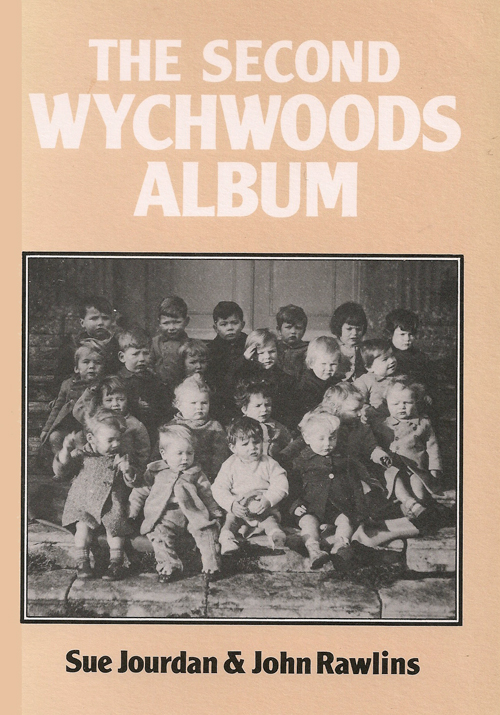
Published in September 1990, the second collection continued the Society’s work preserving the visual history of the Wychwoods.
At the tenth anniversary meeting in April 1991, ten members gave short talks on a variety of topics.
In 1992, after eight years as chairman, Jack Howard-Drake retired in favour of Sue Jourdan, while Janet Wallace and Trudy Yates joined the committee, Trudy finally tackling the recording of oral history.
For the next ten years the Society followed its established pattern of monthly meetings, covering an astonishing range of topics. Talks given by Society members and other local people often proved among the most popular.
Speakers included Michael Aston of Bristol University on landscape archaeology. Once a Milton resident, he later became famous as Professor Mick Aston of television’s Time Team.
The Society heard the Rev Ralph Mann on the Ascott Martyrs, George Lambrick on the Rollright Stones, Brian Durham on Witney Palace and Tom Hassall on his experience as an oarsman on a replica Greek trireme.
There were talks from storyteller Sheila Stewart, Beryl Schumer and W D Campbell on Wychwood Forest, and beautifully illustrated tours of the Cotswolds with Tim Porter.
Shipton old village hall was packed to the roof to hear Dr Celia Miller, author of Rain and Ruin, an edited version of the Victorian diary of a local farmer. Enthusiastic audiences listened to Miss Dor Thomson’s and Professor Hall’s memories of Shipton Court.
Frank Ware retired from the treasurership in 1994, succeeded by Duncan Waugh and then by David Perceval.
Joan Howard-Drake once more became guardian of the archives on Norman Frost’s retirement from the committee after fourteen years’ service. Margaret Ware bowed out from the committee in 1996.
In 1996 Wendy Pearse was interviewed on Shipton Green by two visiting New Zealand historians and can now be seen and heard in the Wellington museum telling the story of nineteenth-century emigration and the tragic sinking of the Cospatrick.
After a few years’ break, the annual fieldwalking programme restarted in 1996. In May 1999 the Society hosted the county’s annual conference of local historical and archaeological societies, Oxfordshire Past.
Later in 1999 James Bond led an extensive survey of the Norman castle and settlement site at Ascott d’Oilly.
CHAPTER 05 2000–2012
In 2000 the millennium was celebrated in grand style with an outstanding exhibition of the Society’s work in Shipton’s New Beaconsfield Hall. Attractions included a 1940s-style kitchen and a thatched Saxon hut with weaving loom and the Society’s own friendly Saxon, David Wilson.
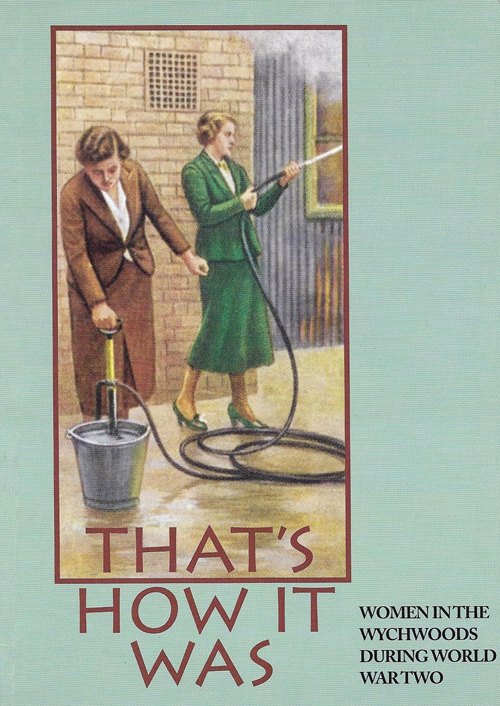
The story of women in the Wychwoods during the Second World War was published for the millennium exhibition.
About 800 people were thought to have visited the exhibition over the weekend.
By 2002 the seventeenth Wychwoods History had been published. In addition to the published work, the Society’s archives had grown to contain a considerable storehouse of information, including a carefully annotated photographic record maintained by John Rawlins.
Membership was maintained at between 150 and 200-plus and included people from various parts of the UK as well as Australia, New Zealand, Canada and the USA.
The first dozen years of the new century ran like a well-oiled machine, with a complete run of Society Journals and full speaker programmes.
The researchers of the Victoria County History group made several appearances during this time, before working in the next decade on the volume covering the Wychwoods.
By the end of this period almost all significant families, buildings or institutions in the Wychwoods had received attention in the Society’s Journal.
In 2005 the Society published The Shipton under Wychwood Constables’ Book, edited by Margaret Ware.
Alan Vickers developed the first website for the Society in 2007 and, thanks to indexing by Joan Howard-Drake, it was possible to link the site to people mentioned in the Journals up to and including Volume 27 in 2012.
Outings included Bletchley Park in 2007 and Gloucester Cathedral and Port in 2008. Liz Woolley took Society members on two organised walking tours of Oxford in 2011, while Wendy Pearse organised a well-attended walking tour of Ascott in 2012.
In 2007 the Society organised two sessions at the New Beaconsfield Hall where elderly and longstanding citizens of the Wychwoods were shown photographs from the Society’s archives in an attempt to identify some of the unknown people pictured.
David Trollope used the newly acquired Shipton electronic projector and John Rawlins attempted to jog memories with varying degrees of success. Bringing local history to those who had made it was clearly much appreciated.
Photographs of these and other events are preserved in the Society archive.
CHAPTER 06 2012
The members’ survey and a Society at a crossroads
Sue Jourdan served as chairman for twenty years before she returned to her home roots of Norwich in 2012. She had a great skill for attracting new committee members and then getting them to take on ‘small tasks’ which tended to last for many years.
The Society held a celebration lunch in appreciation of her service at the Chequers Inn in Churchill and presented her with a watercolour painting of the Lime Tree Walkway by local artist Vernon Dean.
Alan Vickers took over as chairman and decided to carry out a survey of members in 2012 to establish the character of the Society and its wishes at that time. There were 81 replies.
The membership was about 75 years old on average and had been in the Society for 14 years. Many committee members had served for at least ten years and were keen to hand on the baton to younger members.
We had a core of members who could see the need to change but not enough existing members prepared to do the work to make it happen.
Clearly the WLHS was going through a difficult and challenging period. It had an excellent record of achievement in local history going back thirty years, but those achievements had largely been based on traditional technology: pen and paper, photographic film, video and audio tape, printed journals and physical exhibitions.
The Society had yet to exploit the exciting possibilities offered by digital photography, internet publishing, digital sound and video recording and the low-cost transmission of written and visual information around the world.
The full results of the 2012 membership survey remain available online.
CHAPTER 07 A NEW DIRECTION
The Wychwood Magazine had just completed putting its archive of more than thirty years onto a more up-to-date website with search possibilities. A message arrived from Richard Bidgood, formerly a committee member of the WLHS but now living in Kent, describing the exciting efforts made by his new society and encouraging the WLHS to follow their example.
Clearly the Society was falling behind.
Alan Vickers wrote an article in the Wychwood Magazine which painted a picture of the benefits that could accrue to the community if the WLHS could at least match the achievement of the Magazine.
What luxury for anybody anywhere in the world to be able to follow life in the Wychwoods over the last thirty years and even to search by name or topic and at no cost.
How mindboggling would it be to read about life in the Wychwoods over the last two thousand years; search all twenty-eight annual Journals; view thousands of historic photographs; listen to recorded memories of former inhabitants; and view wills from the sixteenth and seventeenth centuries?
All this information was already available to the Society. The technology, equipment and funds were also available. The problem was finding enough people with the time and computer skills to turn those resources into a digital reality.
A small digital scanning team had processed around 300 images, but this represented only around ten per cent of the photographs held by the Society.
If this does not happen then there is a real risk that the excellent Wychwoods Local History Society, which has done such wonderful work for the community over the last thirty years, will be history itself.
This became the template for the Society’s development over the next decade. Much of it has now been achieved, although there is clearly some way still to go.
CHAPTER 08 THE DIGITAL ARCHIVE
Photograph scanning, wills and digital recording
The first action towards embracing technology was to establish a group to begin scanning all the photographs in the Society’s archives, mainly collected by Norman Frost and John Rawlins. By 2014 the group had scanned around 1,000 images.
The efforts of each participant are recorded for posterity through the use of their initials in the individual scan files. By September 2021 the digital photo archive consisted of close to 3,000 files.
| Contributor | Images |
|---|---|
| Edwin Wilson (ELW) | 1,070 |
| Alan Vickers (AWV) | 487 |
| Chris Bailey (CRB) | 333 |
| Ian Drainer (IMD) | 313 |
| Peter Crofts (CPC) | 307 |
| Janet Wiltshire (JVW) | 174 |
| Alan Murphy (AM) | 162 |
| Chris Trotman (CST) | 106 |
| Total | 2,952 |
This virtually covered all of the folders which John Rawlins had assembled. The whole effort took eight years.
Thousands of photographs from the Society’s collection can now be explored online.
By 2015 the Probate or Wills Group was nearing the end of transcribing Shipton parish wills covering the period 1500 to 1732, including the greater Shipton parish taking in Milton and Ramsden. Between 80 and 90 per cent had been completed.
Although the Wills Group was not part of the WLHS, it received funding from the Society and some Society members actively participated, including Joan Howard-Drake and Aelfrith Gittings.
The Society invested in modern technology including a digital recorder, laptop computer and portable scanner. For the first time, in 2016, the WLHS attended both the Milton and Shipton summer fetes with an invitation to scan old photographs brought to the stand.
Interviews were carried out with older Wychwood inhabitants, although not as many as Janet Wallace had carried out nearly twenty years earlier on tape.
On one occasion there was a sad and salutary lesson. Doreen Barnes called on an elderly resident in Milton to record, as arranged, his memories of sixty or seventy years earlier, only to find that he had died. It was a powerful reminder that recording memories could not always be postponed.
CHAPTER 09 2016–2018
Work began on renewing the WLHS website from 2016, but real progress was not made until David Betterton took charge around 2018. David took elements of the old website but considerably expanded the content and made the whole site more informative and useful as a research tool.
Almost all relevant scans produced by the scanning group were edited and uploaded, together with digitised recordings of earlier talks given to the Society.
Production of the Annual Journal came to an end in 2016 with edition 31, the final two issues being edited by Nicola Coldstream. The website consequently became crucial for publishing new research and articles by Society members.
Although the Society had not yet formed a separate buildings group, John Bennett led work describing local historic buildings. He produced a pioneering booklet on the buildings of Milton High Street and organised popular walks around Milton considering key buildings.
While progress was being made in implementing the new digital blueprint, much of the Society’s traditional work continued, including a full programme of speakers and occasional visits.
Regular speakers included Liz Woolley, Tim Porter, Julie Anne Godson and Tony Hadland, alongside presentations from the research team working on the Wychwood Forest and Environs volume of the Victoria County History of Oxfordshire.
The WLHS cooperated closely with the Victoria County History team, which used photographs from the Society’s archives, past research presented in the Journals and local knowledge from Society members.
The Society took on guardianship of several objects of local historical interest. These included a portrait of Dr Brookes, a former Rector of Shipton, which was lent long term to the Care Home at the Prebendal.
Another object given to the Society was the bell from the former ‘tin’ church on Fiddlers Hill, intended to be hung in the Wychwoods Primary School.
Photographic records were made of buildings and changes to sites throughout the Wychwoods, including Dees stores before demolition, new developments in Milton and Shipton, changes to conservation land, the collapse of the Shipton Court stone wall and the upheaval caused by installing fibre broadband.
The Society developed a close relationship with the Wychwood Magazine, sharing photographs, stories and research.
Wendy Pearse stood down in 2013 after 26 years as Secretary. Pauline Holdsworth was Speaker Secretary from 2000 to 2016. Janet Wallace finally left the committee in 2017 after nearly 25 years of service.
Joan Howard-Drake stepped down in 2015 after 35 years of service to the Society dating back to its foundation.
Paula Nielsen took over as Chairman from Alan Vickers in 2016, followed by Roger Watts in 2017. Even then the future of the Society was far from assured, chiefly because of the difficulty of finding people prepared to serve on the Committee.
CHAPTER 10 THE 2020s
The newsletter in 2016 had warned that if new Committee members could not be attracted to fill vacant roles, a proposal might be made to place the Society into ‘hibernation’.
Fortunately new people were found and Roger Watts was able to put together a small but strong committee, including Sue Richards, providing a valued link with the Society’s earliest days, and Janet Wiltshire, a descendant of an Ascott Martyr, as Treasurer.
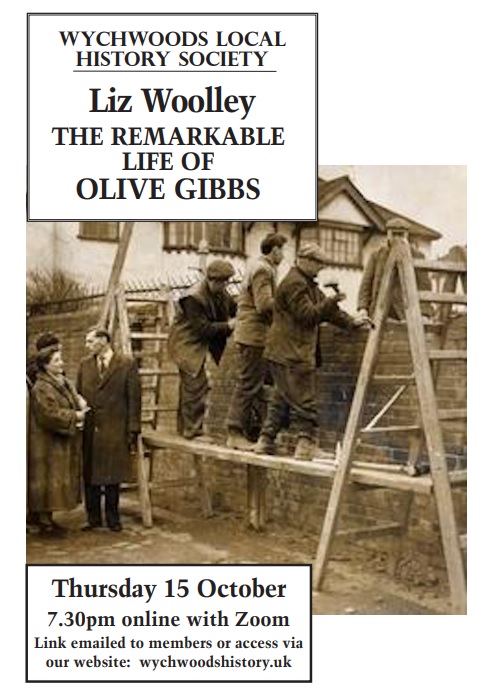
When the Covid pandemic struck in spring 2020, the Society moved its talks programme online.
With meetings no longer possible in Milton Village Hall, Roger Watts arranged for them to move to Zoom. Meetings were also shared with Charlbury History Society.
Attendances were surprisingly good, showing how far the Society had come in reducing the level of aversion to digital technology since the survey of 2012. Subscriptions were suspended for one year in 2020.
The Society looked forward to resuming face-to-face meetings in Milton Village Hall and celebrating its 40th anniversary with a small exhibition and additional material on the expanded website.
Thanks to the efforts of committee member Sue Richards, the Society obtained a generous grant from the Greening Lamborn Trust to digitise the remaining Journals so they could be uploaded to the website in searchable form.
A small amount of scanning of archive photographs remained, alongside the digitisation of audio tapes.
There remained the question of the long-term future of the Society’s physical archives, maintained for so many years by Joan Howard-Drake. Easy access to archive material had always played an important role in enabling original research.
The recording of memories and experiences of older members of the Wychwoods community also remained an important priority.
Just before the pandemic, Alan Vickers visited a number of local history societies in Western Australia. Many had fewer members and less history to cover than the WLHS, but benefited from dedicated buildings, often surplus Victorian properties rented for a peppercorn.
Perhaps similar opportunities could one day be recognised in the Wychwoods.
Clearly there is still much we can do. But we are building on firm foundations.
AWV
September 2021